Digital Communications

Figure 1 · section 2.3

Digital
Communications.

Each bit leaves as a Manchester pulse: a 1 rises in the middle of its cell, a 0 falls. Scroll to send them.

The channel adds white Gaussian noise. As Eb/N0 falls, the received waveform gets rough and the bits get harder to read back.

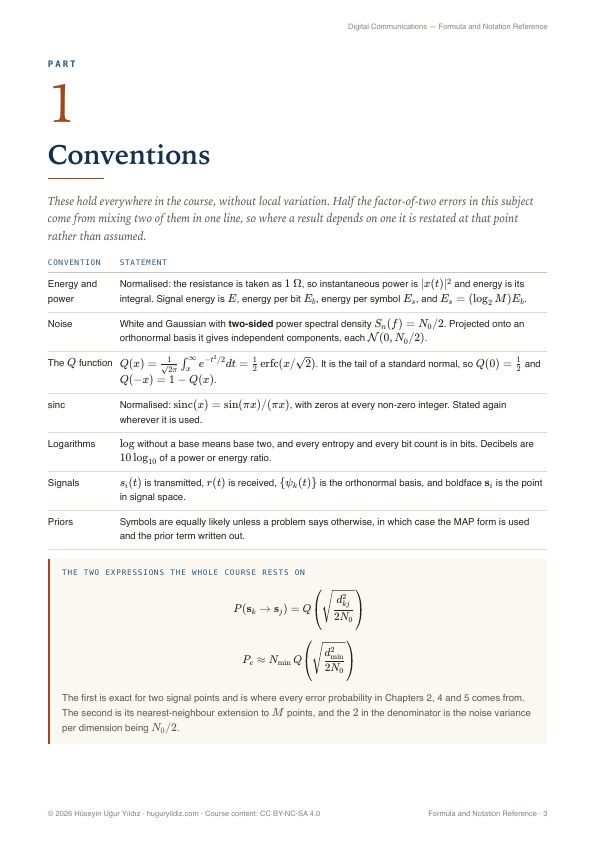
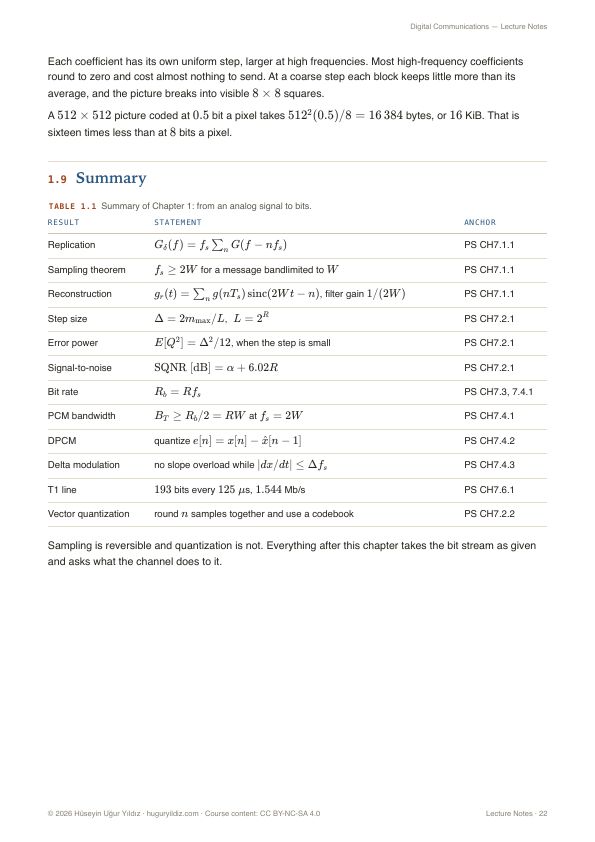
For antipodal signals the bit error probability is Pb = Q(√(2Eb/N0)). From 4 dB to 10 dB it falls by more than three orders of magnitude.
s(t)Manchester code · 1 of 12 bits
Digital Communications · Figure 10%
7modules
339scenes
29laboratories
180worked questions

The course

Seven modules.

A transmitter is given a symbol and sends a waveform. A channel adds noise to it. A receiver observes the sum and decides which symbol was sent. Each module is about one part of that chain.

  1. 0

    Why digital communications?

    What the whole subject asks, why digits are sent at all, and what that costs.

  2. 1

    The transition from analog to digital

    Sampling, quantization and PCM: turning a continuous signal into a finite alphabet, and what the rounding costs.

  3. 2

    Baseband transmission of digital signals

    The matched filter, the decision and its error, intersymbol interference, and the Nyquist pulse.

  4. 3

    Geometric representation of signal waveforms

    Signals as vectors and constellations. Once distance means something, the receiver follows.

  5. 4

    The optimal receiver in AWGN

    The observation, the decision rule, decision regions and the union bound on the error probability.

  6. 5

    Digital modulation methods

    The binary schemes, PSK, QAM and FSK, each measured by the same distance as the last module.

  7. 6

    An introduction to information theory

    Entropy, source coding and channel capacity: the limit that no scheme above can pass.

On paper

Three documents.

Typeset from the same sources as the course, as PDFs.